Suffolk vs Dorset vs Merino: Which Breed Fits Your Farm?
Compare Suffolk, Dorset, and Merino sheep on gestation length, lambing rate, wool production, and management requirements to find the right breed for your operation.
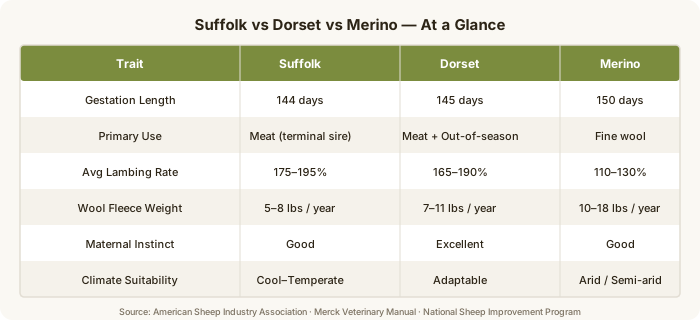
Three breeds dominate discussions among new and experienced sheep farmers alike: Suffolk, Dorset, and Merino. They represent three distinct production philosophies, fast meat production, flexible breeding seasons, and premium fiber, and they perform very differently in the barn and on paper.
Here's a detailed comparison to help you decide which fits your goals. And since gestation length is one of the key variables in planning your lambing season, use the sheep gestation calculator to see exactly when each breed's ewes will lamb based on your breeding dates.
Suffolk: The Commercial Meat Standard
Gestation: 144 days
Primary use: Terminal sire and commercial meat production
Origin: England (Suffolk region)
The Suffolk is the most common sheep breed in the United States, and for good reason. It grows fast, produces a high-yielding carcass, and crosses well with almost any ewe breed. Suffolk rams are widely used as terminal sires, meaning they're mated with ewes of other breeds to produce lambs that go straight to market, not back into the breeding flock.
What makes Suffolk attractive:
- Fastest gestation of major breeds (144 days = earlier lamb crop)
- Lambs are heavily muscled and grade well
- Ewes have good maternal instinct and milk production
- Lambs reach market weight (130–150 lbs) quickly, often in 5–6 months on pasture
Drawbacks:
- Seasonal breeders, most Suffolk ewes won't cycle outside September–February without hormonal intervention
- Heavier body frame means harder deliveries if crossbred with smaller-framed ewes
- Moderate wool clip (5–8 lbs/year, coarse 24–30 micron, primarily used for carpets and felt)
Best for: Commercial operations focused on lamb production, farms selling at auction to feedlots, operations using a rotational crossbreeding program.
Dorset: The Flexible All-Rounder
Gestation: 145 days
Primary use: Meat production, out-of-season breeding, maternal breed
Origin: England (Dorset region)
The Dorset's defining characteristic is its ability to breed outside the normal sheep breeding season. Horned Dorsets in particular can be bred almost year-round, making two lamb crops per year possible. Polled Dorsets are less extreme in this ability but still extend the breeding season compared to Suffolk or most other breeds.
What makes Dorset attractive:
- Out-of-season breeding capability, can produce Easter or spring lambs by breeding in summer
- Excellent maternal instinct and milking ability, ewes are excellent mothers
- Good-sized lambs with high lean-meat yield
- Adaptable to a wide range of climates and management systems
Drawbacks:
- Slightly less muscle depth than Suffolk in terminal crosses
- Out-of-season breeding requires management: rams must be separated during non-breeding periods, nutritional requirements shift
- Wool (7–11 lbs, 26–32 micron) is medium quality, some value, but not premium
Best for: Farms wanting scheduling flexibility (holiday lamb markets), operations producing their own replacement ewes, farmers wanting a breed that does both maternal and meat roles.
Merino: The Fine Wool Specialist
Gestation: 150 days
Primary use: Fine wool production; secondary meat in some crossbreeding programs
Origin: Spain (via Australia as primary modern production base)
The Merino is the world's premier wool-producing breed. Its fleece, typically 17–24 microns, commands premium prices in apparel markets. Australian Merinos dominate global wool production. In the US, Rambouillet (the American fine-wool breed developed from Merino) is more common.
What makes Merino attractive:
- Highest-value wool of any commercial breed, fine-fiber fleeces sell for $4–$12/lb vs $0.50–$1.50 for coarse wool
- Large annual fleece weights (10–18 lbs of greasy wool)
- Hardy and adapted to dry, marginal range conditions
- Long productive life, ewes remain productive into their teens
Drawbacks:
- Longest gestation (150 days), requires accurate record-keeping and careful lambing date planning
- Lower lambing rates (110–130%) than meat breeds
- Wool around the face ("wool blindness") requires regular wool trimming
- Less muscle mass, meat quality is inferior to Suffolk crossbreds
- In humid climates, Merinos are more susceptible to fleece rot and flystrike
Best for: Arid or semi-arid range operations, farms selling raw fleece to fiber mills, producers with access to specialty wool markets (handspinners, artisan yarn companies).
Head-to-Head: Key Production Metrics
| Trait | Suffolk | Dorset | Merino |
|---|---|---|---|
| Gestation | 144 days | 145 days | 150 days |
| Avg lambing % | 175–195% | 165–190% | 110–130% |
| Lamb growth rate | Fast (0.7–0.9 lb/day) | Moderate-fast | Slow (0.5–0.6 lb/day) |
| Wool fleece weight | 5–8 lbs/yr | 7–11 lbs/yr | 10–18 lbs/yr |
| Wool micron | 24–30 (coarse) | 26–32 (medium) | 17–24 (fine) |
| Out-of-season breeding | Poor | Excellent | Moderate |
| Maternal instinct | Good | Excellent | Good |
Crossbreeding: Getting the Best of Both
Most commercial lamb operations don't run purebreds. They use crossbreeding to combine the strengths of multiple breeds:
Suffolk × Dorset or Suffolk × Hampshire: The Dorset provides better mothering and extended breeding season; the Suffolk ram adds muscle and growth rate to the lamb crop.
Merino × terminal sire (Suffolk or Dorper): The Merino ewe contributes fine-wool genetics and hardiness; the terminal sire adds meat quality to market lambs. This is the dominant production system in Australia.
Katahdin or Dorper × Merino: Hair-sheep genetics combined with fine wool can produce "low-maintenance fine wool" sheep that don't require shearing, an emerging niche.
When choosing a cross, remember that gestation length is primarily determined by the ewe's genetics. A Merino ewe crossed with a Suffolk ram still carries for approximately 150 days. Use the lambing date calculator with the ewe's breed to plan your season correctly.
Which Breed Is Right for You?
Choose Suffolk if you're focused on efficient lamb production, sell lambs at live auction or direct to processors, and want fast-growing lambs with high carcass value.
Choose Dorset if you want flexibility in your breeding calendar, prefer a breed that does double duty as both meat and maternal, or are targeting niche markets like Easter lambs or out-of-season grass-fed lamb.
Choose Merino if you're in an arid or range environment, have access to specialty wool markets at premium prices, and are willing to manage the specific requirements of a fine-wool flock (regular shearing, wool trimming, clip preparation).
There's no universally "best" breed, the right answer depends on your land, your market, and what you enjoy managing. Talk to farmers in your region who run each breed, visit a breed association field day, and trial a small group before committing to a full-flock transition.
Whatever breed you choose, keeping accurate breeding records and using our sheep gestation calculator each season will make your lambing management significantly easier.