Signs a Ewe Is About to Lamb: What to Watch For
Learn the physical and behavioral signs that a ewe is ready to lamb, from udder development days before birth to the final hour of active labor.
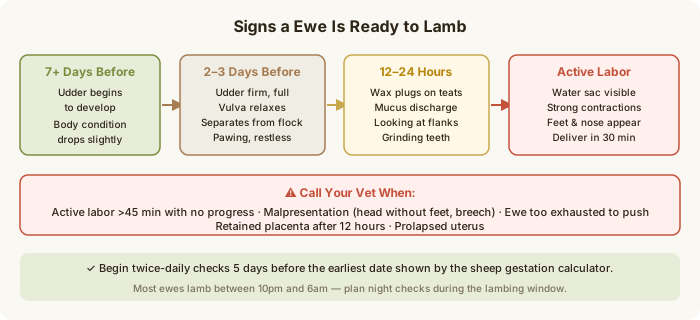
Most ewes give you plenty of warning before they lamb. The challenge is knowing what to look for, and when to watch more closely versus when to leave them alone. Here's a practical guide to reading the signs, from a week out to the moment the lamb hits the ground.
Why Recognizing Pre-Lambing Signs Matters
Knowing your ewe is within 24 hours of lambing lets you move her to a lambing pen before she delivers in the field, reducing lamb losses from exposure, mismothering, and predation. It also means you're present when intervention is needed.
Use our sheep gestation calculator to know when your ewes are approaching their due dates, then watch more closely during the lambing window.
7+ Days Before Lambing: Early Signs
Udder development (bagging up). This is the most reliable early sign. In the final 2–4 weeks of pregnancy, the udder fills with colostrum. In first-time lambers (ewe lambs), udder development may begin earlier, sometimes 4–6 weeks before birth. In older ewes, udder filling can happen quickly, within days of lambing.
Run your hand under the udder daily once you're within 3 weeks of the expected date from your lambing date calculator. You're feeling for firmness and heat, a soft udder is early colostrum; a rock-hard udder often means lambing is imminent.
Body condition changes. The abdomen drops and widens in the final weeks as the lamb(s) descend toward the birth canal. You'll see the ewe's flanks hollow slightly and her belly swing lower. From behind, the tailhead rises as the ligaments around the pelvis relax.
2–3 Days Before: Clear Indicators
Relaxation of the perineal ligaments. These are the two cord-like ligaments that run from the tailhead to the pins (hip bones). When they're tight, you can feel them clearly. In the 24–48 hours before lambing, they soften completely and you can sink a thumb between the ligament and the tail. Experienced shepherds call this "checking the strings". It's one of the most reliable predictors of imminent birth.
Vulvar swelling and discharge. The vulva enlarges and takes on a reddish, glistening appearance. A clear to slightly cloudy mucus string may appear. This is the cervical plug dissolving as the cervix dilates. This discharge is normal. If it's dark brown, rusty red, or foul-smelling, call your vet.
Behavioral changes. The ewe will start to separate herself from the flock. She may stand alone in a corner of the field, pace along the fence line, or refuse to come when the others are called for feed. Pawing at the ground, nest-making behavior, becomes frequent. She'll lie down and get up repeatedly, often turning to look at her flank.
Reduced feed intake. Many ewes go off feed in the 12–24 hours before lambing. Don't panic if she doesn't clean up her hay or grain. This is normal. Keep fresh water available; she'll be thirsty after delivery.
12–24 Hours Before: Imminent Signs
Wax plugs. Small waxy or milky drops appear at the teat ends. This is dried colostrum plugging the teat canal, and it's one of the clearest "within-24-hours" signs. Strip a small amount of colostrum, thick, yellowish, and viscous is ideal. Watery or clear fluid means the colostrum hasn't matured yet; the ewe may still be a day or two away.
Looking at her flank. The ewe repeatedly turns her head toward her belly, responding to uterine contractions. This is often the first sign of early labor contractions beginning.
Grinding teeth (bruxism). A stressed or uncomfortable ewe will grind her teeth. During pre-lambing, this indicates uterine discomfort from early contractions. It's not a reason to intervene, just a sign to watch closely.
Vocalizations. Some ewes, particularly those that have lambed before, will start baaing softly, almost a low rumble. First-time lambers are often quieter. If you see a normally quiet ewe suddenly vocalizing, move her to a lambing pen.
Active Labor: Stage 1 and Stage 2
Sheep labor has two active stages:
Stage 1 (cervical dilation, 2–6 hours). The cervix fully dilates. Contractions are occurring but the ewe may not strain visibly. She'll be restless, lying down then standing, turning in circles. The water sac (allantochorion) may appear at the vulva, a clear, fluid-filled balloon. This is normal; don't break it.
Stage 2 (fetal expulsion, 30–45 minutes). Active straining begins. You should see feet and a nose within 15–30 minutes of hard pushing. Normal presentation is front feet first with the head resting on the knees, chin pointing forward. One foot slightly ahead of the other is also normal, the lamb's shoulders clear the pelvis more easily this way.
A lamb should be fully delivered within 45 minutes of active straining. If it's been longer than that with no progress, check the presentation and call your vet.
When to Intervene
Most deliveries need no help. Intervene when:
- Straining for 45+ minutes with no progress or only a head with no feet showing
- Abnormal presentations: breech (tail/rump first), head back with feet, one leg retained
- Ewe is exhausted and has stopped straining but the lamb isn't delivered
- Lamb's tongue is blue and swollen (indicating the head has been presented too long, oxygen-deprived)
- Only one foot showing: the other leg may be hooked on the pelvis
If you need to assist, clean your hands and arms thoroughly, use OB lubricant generously, and work with the ewe's contractions rather than against them. If you can't resolve the problem in a few minutes, stop and call your vet.
After the Lamb Is Born
Once the lamb is on the ground, check:
- Airways. Clear mucus from the nose and mouth. If the lamb isn't breathing, rub it briskly with a towel and swing it gently (holding the hind legs, supporting the head) to clear fluid.
- Navel. Dip in 7% iodine solution immediately to prevent navel ill (omphalitis). Dip again at 4–6 hours.
- Colostrum. The lamb must nurse within the first 4 hours. Colostrum provides immunoglobulins and energy. If the ewe rejects the lamb or the lamb is too weak to stand, tube-feed fresh or frozen colostrum.
- Ewe-lamb bonding. Keep them in the lambing pen for at least 24–48 hours. The ewe imprints on the lamb's smell; disruption in this window causes rejection.
Checking for More Lambs
After the first lamb is delivered, watch for a second or third. Twins are common, many breeds average 180–190% lambing percentages. The ewe will often start straining again within 15–30 minutes of delivering the first lamb. The second lamb usually comes faster. After all lambs are out, the placenta (afterbirth) should pass within 2–4 hours. Note the time, retained placenta after 12 hours requires veterinary attention.
Keep an eye on your breeding calendar and use the lambing date calculator each season to track when your ewes are due. The earlier you know, the better prepared you'll be.