Sheep Nutrition During Pregnancy: Feeding Your Ewes Right
A practical guide to feeding pregnant ewes from breeding through late pregnancy, covering energy, protein, minerals, and how litter size changes requirements.
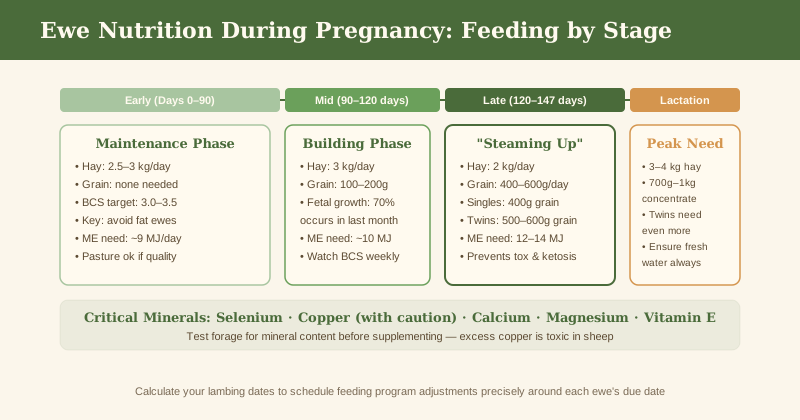
Feeding pregnant ewes correctly is one of the highest-leverage management decisions in sheep farming. Underfeeding in late pregnancy kills ewes (pregnancy toxemia) and produces weak, small lambs. Overfeeding produces obese ewes with difficult births and lazy-mothering syndrome. Getting it right isn't complicated, but it requires understanding how nutritional needs shift across the three trimesters.
Use the sheep gestation calculator to know exactly where your ewes are in their pregnancy, then match the feeding program below to their stage.
The Nutritional Demands of Pregnancy: An Overview
Sheep pregnancy breaks into three nutritional phases:
Early pregnancy (days 1–90): Low additional demand. Fetal growth is minimal.
Mid pregnancy (days 91–110): Moderate increase, especially for multiples.
Late pregnancy (last 6 weeks, approximately days 100–147): Dramatic increase. 70% of fetal growth occurs here.
Many farmers make the mistake of feeding heavily throughout pregnancy, or, more dangerously, ignoring nutrition until the last moment. Neither approach works. Early overfeeding produces fat ewes; late underfeeding produces dead ewes and dead lambs.
Early Pregnancy: Maintenance Plus a Little
In the first 90 days, embryos are tiny. A ewe carrying twins at day 45 has fetuses that weigh a combined total of a few grams. Her nutritional needs are only slightly above maintenance, roughly 10–15% above non-pregnant requirements.
Focus in this phase:
- Maintain body condition. Target BCS 3.0–3.5 going into mid-pregnancy. Fix any thin ewes now. It's much harder to add condition safely in late pregnancy.
- Quality hay is sufficient. Mixed grass-legume hay or good pasture is all most ewes need. High-quality legume hay (8–10% protein, 60–65% TDN) provides both energy and protein for early pregnancy without supplementation.
- Avoid sudden ration changes. Rumen microbes need 2–3 weeks to adapt. Switching abruptly from pasture to dry hay, common after frost kills pasture, can temporarily depress intake and rumen function. Transition over 10–14 days.
Common mistake: Feeding grain continuously from breeding through mid-pregnancy "just to be safe." This builds condition excessively in ewes that don't need it and sets up problems at lambing (obese ewes have smaller pelvic openings, are prone to prolapse, and often have poor maternal behavior).
Mid-Pregnancy (Days 90–110): Scanning and Sorting
This is the time to ultrasound-scan your flock for litter size, if you haven't already. Knowing which ewes carry singles, twins, and triplets at mid-pregnancy lets you create feeding groups for the critical late-pregnancy period.
Scanning services vary by region, some farmers have portable units and do their own, others hire a scanning technician. The cost (typically $2–4 per ewe in a group) pays for itself immediately in reduced feed waste and reduced pregnancy toxemia losses.
Feeding groups:
- Singles: maintenance plus 15–20% extra
- Twins: maintenance plus 40–60% extra
- Triplets: maintenance plus 75–100% extra
At this stage, good hay plus a mineral supplement handles most of what singles and twins need. Triplet-bearing ewes may need small grain supplementation starting at day 100.
Late Pregnancy: The Critical Period
The last 6 weeks of pregnancy are where the feeding rubber meets the road. The fetuses grow exponentially, and the ewe's rumen gets progressively compressed, meaning she physically can't eat as much per sitting even as her demands increase.
Key principles:
Feed little and often. Split the daily ration into 2–3 feedings rather than one large dump. This maximizes intake in a compressed rumen. Many shepherds give fresh hay morning and evening, with grain at midday.
Use high-density feeds. As rumen capacity decreases, energy density per mouthful becomes critical. Switch from grass hay to legume hay (alfalfa, clover) or add grain. Legume hay (15–18% protein, 62–66% TDN) provides significantly more nutrients per pound than grass hay.
Target amounts (rough guides per ewe per day, last 6 weeks):
| Litter size | Good-quality hay | Concentrate (corn/barley) |
|---|---|---|
| Single | 3–4 lbs/day | 0.25–0.5 lbs/day |
| Twins | 3.5–4.5 lbs/day | 0.5–0.75 lbs/day |
| Triplets | 4–5 lbs/day | 1.0–1.5 lbs/day |
These are starting points, adjust based on body condition. If ewes are losing condition despite these rations, increase concentrate. If they're gaining beyond BCS 3.5, reduce.
Protein. The last 6 weeks also have elevated protein requirements, 12–14% crude protein in the total diet. Good legume hay covers most of this. If feeding straight corn (low protein), add a protein supplement (soybean meal, commercial ewe supplement) to meet requirements.
Mineral Nutrition in Pregnancy
Mineral deficiencies in pregnant ewes cause specific problems:
Selenium/Vitamin E deficiency → White Muscle Disease (WMD) in newborn lambs. Lambs are born with stiff, weak muscles; often can't stand or nurse. Regions in the Pacific Northwest, Northeast, and Upper Midwest are commonly selenium-deficient. If your area is deficient, inject ewes with selenium/Vitamin E (BoSe or equivalent) 4–6 weeks before lambing. Don't inject without knowing your soil selenium status, selenium toxicity is as dangerous as deficiency.
Calcium deficiency → milk fever (hypocalcemia). Rare in sheep compared to dairy cattle, but occurs in heavily milking ewes of high-producing breeds (Dorset, East Friesian). Usually appears within 24–48 hours of lambing. Treat with IV or subcutaneous calcium gluconate.
Copper deficiency → swayback (enzootic ataxia) in newborn lambs. Lambs are born unable to walk properly, with a characteristic swaying gait. A genetic condition, copper-dependent enzymes fail to develop the myelin sheaths of spinal nerve fibers. Supplementing copper-deficient ewes during mid-pregnancy largely prevents it. (Note: many sheep minerals are copper-restricted because of breed susceptibility to copper toxicity, Texel and some other breeds are especially sensitive. Use sheep-specific minerals, not cattle minerals.)
Use a sheep-specific loose mineral. Sheep require different mineral ratios than cattle. A good sheep loose mineral (copper-appropriate, selenium-appropriate for your region) available free-choice covers most bases. Don't offer cattle mineral to sheep without checking copper levels.
Water
Water is often overlooked in nutrition discussions, but pregnant ewes in the last 6 weeks need 1–1.5 gallons per day depending on temperature and diet. Dry hay diets require more water than pasture. In cold climates, break ice twice daily or use heated waterers, ewes won't eat adequate amounts of frozen water, and dehydration triggers reduced feed intake and, in severe cases, urinary calculi.
Monitoring: Body Condition Scoring Through Pregnancy
The most practical monitoring tool is BCS. Score your ewes at:
- Breeding (day 0): Establish baseline. Target 3.0–3.5 for most breeds.
- Mid-pregnancy (~day 75): Check for condition loss. Identify thin ewes and increase their ration.
- 3 weeks before lambing (~day 120): Final condition check. Adjust concentrate levels accordingly. Don't try to push thin ewes dramatically at this point, rapid weight gain in late pregnancy can disrupt fetal positioning.
Use the ewe gestation calculator to track these key calendar dates from your breeding date. Then set a calendar reminder to score body condition at each checkpoint.
Good pregnancy nutrition isn't about throwing more feed at more ewes. It's about matching the right amount and type of feed to each ewe's actual stage and litter size. Do that, and you'll have stronger lambs, healthier ewes, and fewer veterinary emergencies, which is exactly what a good lambing season looks like.