Twin Lamb Disease (Pregnancy Toxemia): Prevention and Treatment
Pregnancy toxemia in sheep, also called twin lamb disease, kills ewes in late pregnancy. Learn the causes, early signs, treatment, and how to prevent it.
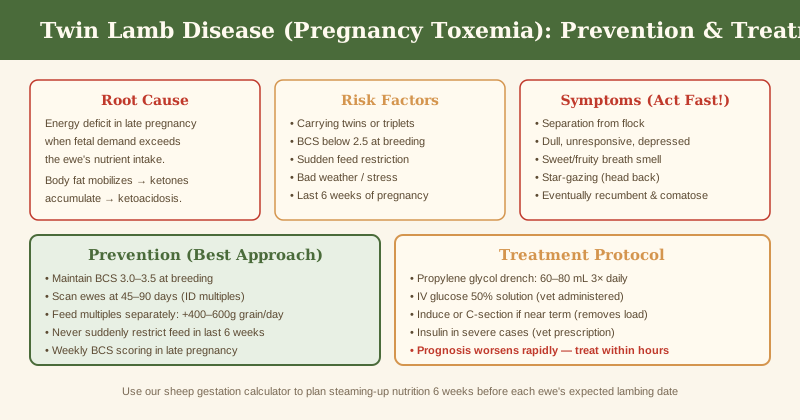
Pregnancy toxemia, commonly called twin lamb disease, is one of the most preventable causes of late-pregnancy ewe death in sheep farming. It kills ewes in their final weeks of pregnancy, after months of investment in the animal. Understanding why it happens and how to stop it before it starts is essential for any sheep operation.
What Is Pregnancy Toxemia?
Pregnancy toxemia is a metabolic disorder caused by energy deficit in late pregnancy. When a ewe's energy demands exceed what her diet supplies, her body starts breaking down fat reserves to compensate. This releases ketone bodies (acetoacetate, beta-hydroxybutyrate, acetone) into the bloodstream faster than the liver can clear them. The buildup of ketones is toxic, hence toxemia.
The name "twin lamb disease" comes from the fact that ewes carrying twins or triplets are at highest risk. Multiple fetuses dramatically increase energy demand in the last 6 weeks of pregnancy. A ewe carrying triplets may need 2.5–3 times her maintenance energy requirements in the final 2 weeks, a demand that's very easy to fail to meet.
If you're tracking due dates with the sheep gestation calculator and a ewe is within 6 weeks of her predicted lambing date, she's entering the risk window for this condition.
Who Gets It?
Pregnancy toxemia can affect any pregnant ewe, but certain groups are at dramatically higher risk:
Multiple-bearing ewes. Twins account for the majority of cases. Triplet-bearing ewes are at the highest risk of all.
Ewes in poor body condition (BCS 1.5–2.5). Thin ewes have limited fat reserves to draw on. When energy demand exceeds intake, thin ewes run out of reserves faster than well-conditioned animals.
Obese ewes (BCS 4.0+). Counterintuitively, very fat ewes are also at risk. Fat deposits around the abdominal organs and in the rumen wall reduce rumen capacity, limiting how much feed the ewe can physically consume. As the fetuses grow and compress the rumen further, appetite drops at exactly the wrong time.
Ewes in late pregnancy with limited feed access. Competitive feeding situations where timid ewes can't access adequate nutrition, or where feed quality drops suddenly (e.g., poor hay, exhausted pasture), trigger cases.
Ewes under stress. Sudden weather changes, transport, regrouping, or dog attacks in late pregnancy can precipitate toxemia in ewes already marginal on energy.
Signs of Pregnancy Toxemia
The condition progresses through stages over 3–5 days. Recognizing it early dramatically improves survival odds.
Early signs (day 1–2):
- Lagging behind the flock at feeding time
- Dull, listless appearance; less reactive than normal
- Reduced appetite, not finishing hay or concentrates
- Mild unsteadiness or wobbliness when walking
Progressive signs (day 2–3):
- Clear separation from the flock; standing alone
- Head pressing against fence posts or walls (neurological effect)
- Grinding teeth (bruxism)
- Reluctance or inability to rise
- Sweet, fruity smell on the breath (acetone, a ketone body)
Advanced signs (day 4–5):
- Unable to stand without support
- Tremors, circling, apparent blindness
- Seizures
- Recumbent (can't rise at all)
Once a ewe is recumbent from pregnancy toxemia, the prognosis is guarded even with treatment. Early detection and treatment are essential.
Treatment
Treatment has two goals: supply glucose immediately and reduce further fat mobilization.
Propylene glycol (PG). This is the standard first-line treatment. Propylene glycol is a glucose precursor absorbed directly in the rumen and converted to glucose in the liver. Dose: 60–100 ml orally, 3–4 times per day. Use a drenching gun. Continue until the ewe is eating normally.
IV glucose. For ewes that can't stand or are severely affected, intravenous 50% dextrose solution (given by a veterinarian) provides immediate blood glucose. This is more effective than oral treatment for advanced cases but requires veterinary involvement.
Induced lambing or caesarean section. Delivering the lambs removes the major energy drain immediately. If the ewe is within 2 weeks of her expected due date (check the lambing date calculator for the exact timeline) and treatment is failing, your vet may recommend inducing labor with dexamethasone or performing a caesarean. Induced lambs before 145 days are premature and may not survive, weigh this carefully.
Supportive care. Separate the ewe from competition for feed. Offer premium hay (legume or alfalfa, not just grass), fresh water, and small amounts of easily digestible concentrate 3–4 times per day. Electrolytes can help maintain hydration.
Prevention
Prevention is far more effective than treatment. The strategy is simple: don't let ewes fall into energy deficit in the last 6 weeks of pregnancy.
Body condition scoring at breeding and at mid-pregnancy (75 days). Target BCS 3.0–3.5 going into late pregnancy. Fix problems while there's time. You can put condition on a ewe at 75 days; you can't do it safely at 130 days.
Identify multiple-bearing ewes. Ultrasound scanning at 70–90 days post-breeding identifies twins and triplets. Separate twin- and triplet-bearing ewes and feed them a different ration, they need more energy than singles can profitably receive.
Feed by body condition and litter size. Multiple-bearing ewes in the last 6 weeks need roughly:
- Singles: Maintenance + 40% extra (0.5–0.75 lb concentrate/day)
- Twins: Maintenance + 75% extra (0.75–1.0 lb concentrate/day)
- Triplets: Maintenance + 100–120% extra (1.0–1.5 lb concentrate/day)
These are rough guides, actual requirements depend on ewe size, forage quality, and temperature. Consult Penn State Extension's sheep nutrition tables or your local extension agent for precise rations.
Don't make sudden feed changes. Rumen microbes need 2–3 weeks to adapt to diet changes. Sudden introduction of high-grain rations can cause grain overload (acidosis); sudden removal of good pasture to poor hay can trigger toxemia. Transition slowly.
Ensure adequate feed access. Allow 18–24 inches of feeder space per ewe. In competitive flocks, timid ewes will be pushed off the feeder. In the last 3 weeks, consider feeding twice daily to ensure all ewes get their share.
Identify and flag high-risk ewes. Any thin ewe, any ewe carrying triplets, any ewe that's been off feed for a day, flag them with a paint mark and watch them closely. Propylene glycol preventively (50 ml/day) is cheaper than treating a down ewe.
Key Takeaway
Pregnancy toxemia is entirely preventable with good nutrition management and monitoring. The investment, ultrasound scanning, premium feed for multiple-bearing ewes, daily observation, pays for itself in saved ewes and lambs. Know when your ewes are entering the high-risk window by using the sheep gestation calculator, and start steaming up feed 6 weeks before the earliest expected lambing date.